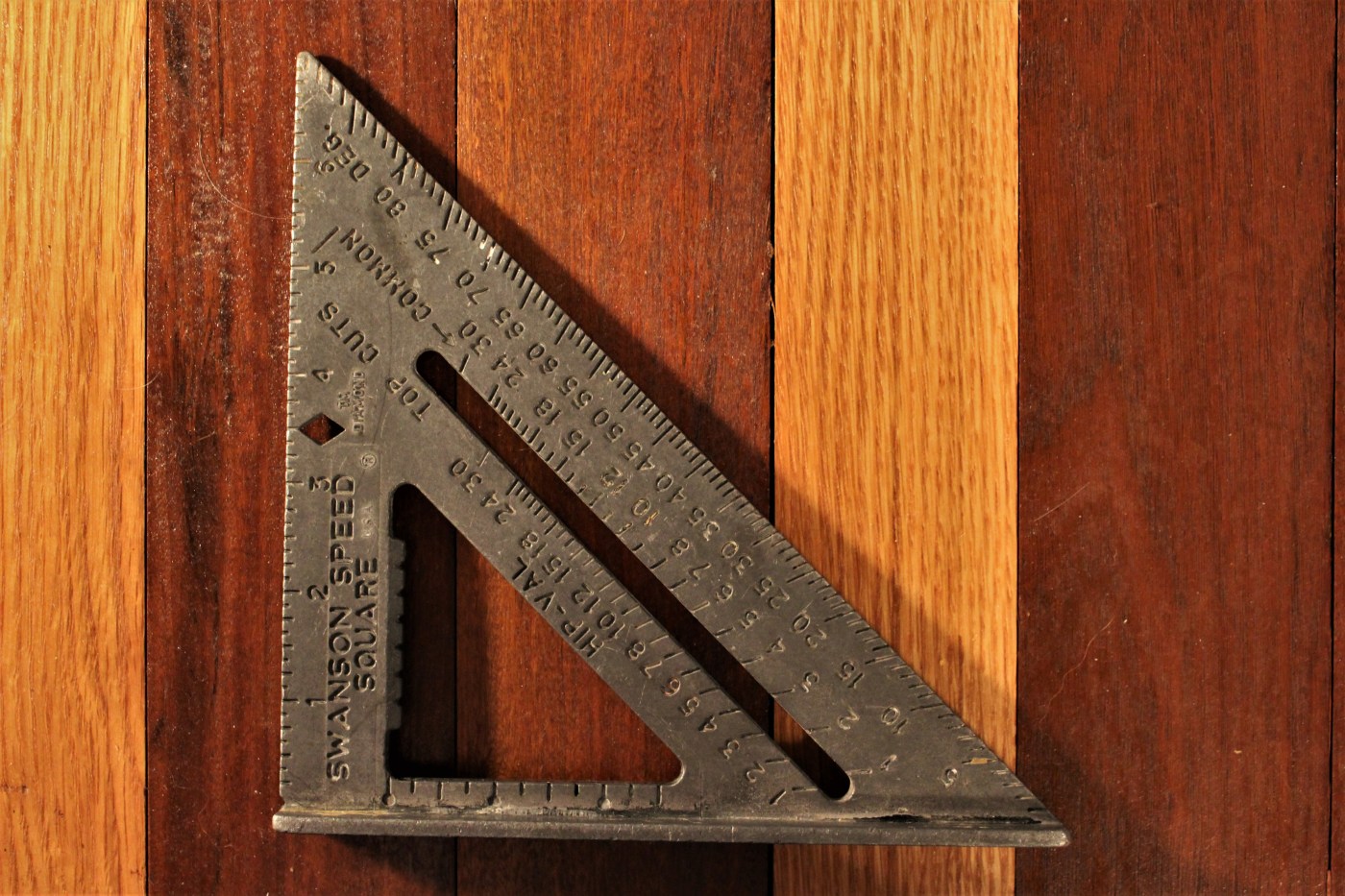
My father didn’t say a word as he switched from tool to tool to get just the right bend on a piece of metal. On his knees before the patio door, he snipped and clipped and crimped until the long strip of aluminum at last matched the profile of the wall. My father was meticulous in his craft. I stood beside him, equally silent, and handed him each new implement like a nurse aiding an ingenious surgeon.
“Your mother wants me to finish the siding before the end of the summer,” he said without looking up. “You’d think I could at least get a sandwich in the mean time.” He attempted to slide the metal along the patio and up under a piece of siding below the threshold. Halfway in, the metal stopped sliding and my father started swearing.
“Should I lift up on the-“
“No, goddammit,” he snapped. “You can back up so I can have some room to maneuver this shit.”
I backed up immediately. The comment did not aid my knotted stomach. I wanted to talk to him, to ask for whatever paternal wisdom he had to offer. This was not the right moment.
He slid the bane of his afternoon out from under the siding and set it aside, careful not to twist or bend the custom tailored strip. Then he pressed his face to the concrete, placing his eye directly upon the floor, and lifted up the Forest Green vinyl as high as its flexibility would allow.
I stared on helplessly. I would’ve liked to have helped. I could have held up the siding. I could have handed him the pry bar, for which his hand searched out blindly. I could have gone inside and made him a sandwich. I continued to watch in silence.
“There might be a nail sticking out,” I offered timidly.
“No shit,” he replied rather listlessly, for he had just discovered the source of his current troubles and was in the process of removing it. “There you go, you little bastard.” The last word was saturated in a thick Boston accent. Not a single “r” was pronounced in the entire sentence.
“It’ll slide right in for sure, now,” I said encouragingly.
My father looked at me out of the corner of his eye as he blew a bit of dirt off of the gleaming white aluminum. “Don’t jinx it.”
Upon this attempt the metal did, in fact, slip nicely into place – under the siding and flat along the patio. Not a drop of water would ever penetrate the force field my father had erected around his home. The roof was protected by the best shingles the industry had to offer. Double-pane, UV resistant, argon-filled windows installed. Tyvek house wrap. R-30 insulation. PVC trim boards. Four hundred feet of weather-stripping. And about ten cases of waterproof, mildew-resistant, brilliant white, silicone caulking to seal himself and my mother into the house that he never wanted to own in the first place.
Lying on his side, with his clever left hand he both bent up the siding and held a nail, as he ever-so carefully hammered the nail home with his right. The sound of the hammer echoed across four acres of pine forest. The tops of the trees swayed in the April breeze. The needles upon their intertwining branches rustled like a brush through long, silken hair. The great, black trunks creaked and groaned. The entire back yard was alive – a natural symphony brought to perform by the impetus of the wind.
Neither of us said a word. Acid was slowly burning a hole through my stomach lining. My heart pounded. My pulse ran deafening in my ears. My mouth opened, but nothing came out. The words cycled through my mind like a merry-go-round and only made me queasier.
The aluminum was finally secure enough to meet my father’s strict standards for home improvement. He sat up and began to collect the tools strewn about the patio area, placing them each in their assigned homes within his tool box.
“So.” The word dribbled out from between lips to my great amazement. I felt relief.
He continued to gather his tools.
Had he not heard me? The wind picked up and the roar of the woods swelled. The tall pines bent beneath the blowing and moaned under the pressure. Perhaps my slight utterance had been carried off upon the air, or suppressed by the muffling torrent. It was a sign. I never should have brought it up. What did he know, anyways? Who was he to give advice on my-
“So what?” he said above the clamor. He didn’t wait for an answer. He picked up the weathered tool box and made for the garage. I followed behind him, desperate to either begin the conversation or change the subject completely. I thought of topics to discuss: the Red Sox, the weather, work. These were our “go to” conversational pieces whenever he felt the need to talk to me.
He entered the garage through the back door. I stepped in quickly after him. The world fell silent within the dark, well-insulated, work shop as the vacuum seal around the door sucked to an airtight closing. Not a trace squeak of the upheaval outside could be heard.
My father flipped a single switch and the entire five hundred square foot garage was illuminated by florescence. By their buzzing radiance, thousands of silver tools shone in perfect array, like soldiers marching off to war. Directly in front of me hung twenty pairs of metal snips, each specifically designed for a specific cut. Beside their display hung hammers of every type, crow bars, pry bars, and cats paws. As I spun about, I gazed in wonder – as I had since childhood – at the enviable collection of hand tools and power tools, from wrenches and socket sets to cordless drills and chainsaws. Then there was cabinet after cabinet, each fastidiously stocked with every piece of hardware that could be put in, on, or under a house. Shelf after shelf of nails – ten penny, sixteen penny, roofer, siding, and trim. Sheet rock screws. Coarse thread. Fine thread. Hex head. Philips head. Flat head. Pipe fittings. Wire nuts. Lids, labels, and flawless order. The entire sterile, gleaming room was a testament to my father’s exactness, his foresight, and his determination to govern every last detail of his life and the lives of those around him.
“So what?” he asked again. He had begun to sweep the floor.
I considered baulking. It didn’t have to come up. Not now. Eventually, but not now.
“So I’m not sure if I want to move after all,” I vomited.
“Why?” he asked. The question at once put me on the defense, tempting me to seek shelter in the deep cracks of ambiguity. I knew it would be asked. I had an answer prepared. But “why” did not ever ask for my ideas or concerns. “Why” was never an honest, probing interest in my thoughts or feelings or fears. “Why” was an indictment. “Why” was condemnation. “Why” was a brief opportunity to express myself before being told, beyond uncertainty, that I was a complete and utter dumbass.
“I’m not sure about the whole job thing,” I began. I scratched at my cheek and stared at the growing pile of sweepings as I continued to speak out of the side of my mouth. “I don’t think I’m going to like it-“
“How would you know if you’ll like it or not? You’ve never experienced it.”
Logic. My father’s brain accepted information like a computer. Through the synapses and chemical formulas the information traveled at lightning speed as it was added, subtracted, multiplied and divided, until at last, a concrete, unerring solution was attained. If my proposed hypotheses did not support the solution in his brain, then I was undoubtedly incorrect.
“Yeah I know,” I acquiesced. He was nearly finished sweeping the floor. When he was done, he would go into the house, shower, complain to my mother about having nothing to eat, and then fall asleep in his chair in front of whichever broadcast sporting event would provide the best white noise. I would have to make my point soon. “I’m going to miss people, I guess. I just don’t think I want to move away. I’m happy here.”
“What about Sally?” My father loved my wife more than his own. Sally laughed a lot, and smiled. He saw in her what my mom used to be and how much he had once loved her. He would do anything to make sure that laughter never faded.
“She wants to move still, I think.”
The sweeping was finished. He hung the broom back upon its hook. The whisk broom and dust pan were taken up.
“She moved all the way out here to be with you five years ago,” he began. As he loaded the dust upon the plastic pan, he similarly swept up the remains of the conversation. “You have to be willing to move for her, too. It’s only fair. That’s what it is to be married. You have to sacrifice for one another.” He flicked the last speck of powder-white dust upon the pan. Without looking at me he emptied the pan in the trash can and made for the door. “Turn off the lights when you’re done in here.”
There it was. The last nail my father set that day was in my proverbial coffin. And he was right. Marriage does include sacrifice. Through the years my father had shown me true sacrifice. He, too, moved for his wife. He left a profitable business as a self-employed contractor to work for condescending pricks in a big box store. He built a house that contained not a single room that he could call his own. He sold his motorcycle. He worked all day. He worked most nights. He missed his son growing up. He was the poster child for the self-sacrificial and long-suffering provider. All for his family. All for his wife. And he resented her every day for it.
 B David Larson
Leave a comment